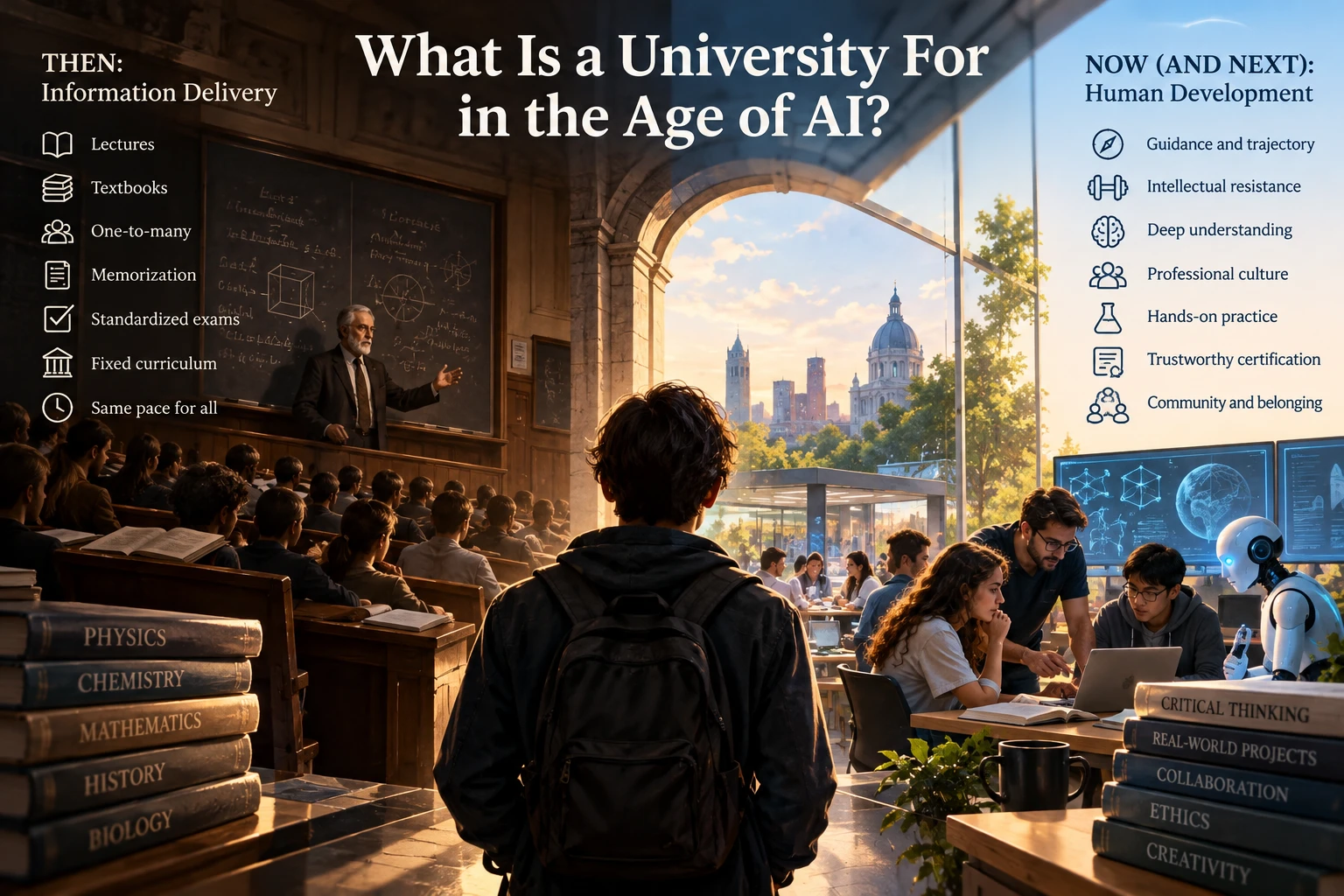
AI forces us to ask a rather uncomfortable question about universities: what are they actually for?
If a university is primarily a place where a knowledgeable professor transfers knowledge to students who do not yet have it, then a substantial part of that model is indeed becoming obsolete. Lectures were once a brilliant technology. Books were expensive, libraries were local, experts were scarce, and a personal tutor for every student was an impossible luxury. The internet seriously weakened that model. AI may be finishing the job.
For the first time, any student has access to an almost free individual tutor that can explain the same idea ten times in ten different ways, adapt to the student’s level, answer questions, generate exercises, and immediately analyze mistakes.
In some respects, it is already pedagogically better than the average lecturer. It does not get tired after teaching three classes. It does not become irritated by a foolish question. And it does not have to explain the same material simultaneously to thirty people with radically different backgrounds.
So the argument that “universities are needed to provide knowledge” is becoming increasingly weak.
But it does not follow that universities are no longer needed.
First, a university provides a trajectory.
A beginner does not merely lack answers. A beginner does not know which questions need to be asked. A first-year materials science student does not yet know why thermodynamics, crystallography, phase diagrams, diffusion, and fracture mechanics matter, how deeply each subject must be understood, or in what order they should be learned.
The good professor is therefore becoming less important as a source of information and more important as someone capable of saying: You must know this. This is useful. This is currently fashionable but secondary. And here you understand the subject so poorly that you are not yet capable of formulating the right question.
Second, a university provides resistance.
Self-directed learning naturally takes us toward things that are interesting, comprehensible, and pleasant. Education repeatedly forces us to go where we would rather not go. AI can become the perfect accomplice to intellectual comfort: endlessly explaining, suggesting, helping, and producing the pleasant sensation that we understand.
Notice that this is the other side of the very virtues listed above. An AI tutor never gets tired and never gets irritated by a foolish question — but for the same reason, it never refuses, never insists, and never tells the student that the question itself is the problem. Its patience is its greatest pedagogical strength and, at the same time, its greatest pedagogical weakness.
At some point, a university has to say: No. Now solve it yourself. Or even harsher: This belongs in the bin! Go away, think, and do it again. Because the purpose of an educational problem is not to obtain the answer. Answers are now almost free. The valuable product is the change that takes place in the student’s mind while arriving at the answer.
This also means that assessment must change. If an assignment can be completed with AI in twenty seconds, evaluating the finished product tells us very little. We need to evaluate capability instead. Here is an unfamiliar problem. Here are the data. You may use AI. Explain what you are doing. Why did you choose this method? Why is the result physically reasonable? Now find the mistake in the AI’s answer.
And here we encounter a paradox: to use AI well, you still have to know something yourself.
An expert can read a beautifully written answer and sometimes sense that something is wrong even before identifying the precise error. A beginner reads the same answer and thinks: how convincing! That intuition comes from an internal model of the field built over years. It cannot be fetched on demand from an external device.
AI may therefore reduce the need to memorize enormous amounts of reference information while simultaneously increasing the value of well-organized fundamental knowledge.
Third, a university introduces students to a professional culture.
A chemist is not simply someone who knows a great deal of chemistry. A chemist knows what counts as evidence in chemistry; when not to trust a beautiful graph; when an experiment must be repeated; where a reasonable approximation becomes an unjustified one; what a suspicious result looks like; and what the data do and do not allow one to claim.
Much of this knowledge is difficult to formalize. It is a craft. It is learned by working alongside other people.
Finally, universities perform two functions we do not always like to discuss: socialization and certification.
They place young people in an environment where they encounter people smarter than they are, less capable, more experienced; where they argue, compete, cooperate, fail, and gradually enter a professional community.
And an academic degree tells the outside world more than “this person has completed a certain number of courses.” It says: for several years, we placed various obstacles in this person’s path and independently tested whether they could overcome them.
The cheaper AI makes the production of impressive essays, software, projects, and portfolios, the less the finished product itself can be trusted — and the more valuable reliable verification of actual competence becomes.
So perhaps the university will not disappear. Perhaps the 20th-century university will.
Much of the transmission of information can be delegated to machines. Initial explanations can go to machines. Practice can become a collaboration between student and machine. Reference information can live entirely outside the classroom.
And expensive human faculty time can be reserved for what humans are actually needed for: setting problems, discussion, laboratory work, projects, detecting misconceptions, intellectual confrontation, and evaluation.
The university would then become less like a school and more like a workshop.
The professor would not disappear. The professor as a talking textbook would.
But that immediately raises an even more uncomfortable question.
Why four years? Why semesters? Why should a lecture last 45 or 90 minutes? Why should twenty or a hundred people learn the same subject at the same pace? Why should a degree be a one-time award at the end rather than a continuously updated map of genuinely verified competencies?
Almost none of these are laws of education. They are historical artifacts of organizing mass education.
So perhaps the real question of the AI age is not:
“Do we still need universities?”
It is:
“Which parts of the modern university are actually essential to a university — and which are merely obsolete technologies for delivering information?”