(A nocturnal dialogue, not in a smoke-filled kitchen)*
You can check out any time you like, but you can never leave. — Eagles, “Hotel California”
There was once, in a strange country, a particular genre: the philosophical conversation in a smoke-filled kitchen. In my case, though, it usually happened not in a kitchen but in the watchman’s cubbyhole of a city school. Weather permitting, and if the mosquitoes weren’t laying siege, not even in the cubbyhole but out on the front steps. We’d carry chairs out there, set down a three-liter jar of tea, and talk for a long time. Night is a good time for that kind of talk. Slow, unhurried, viscous. Toward morning we’d walk home through the early cold, one more night gone without sleep.
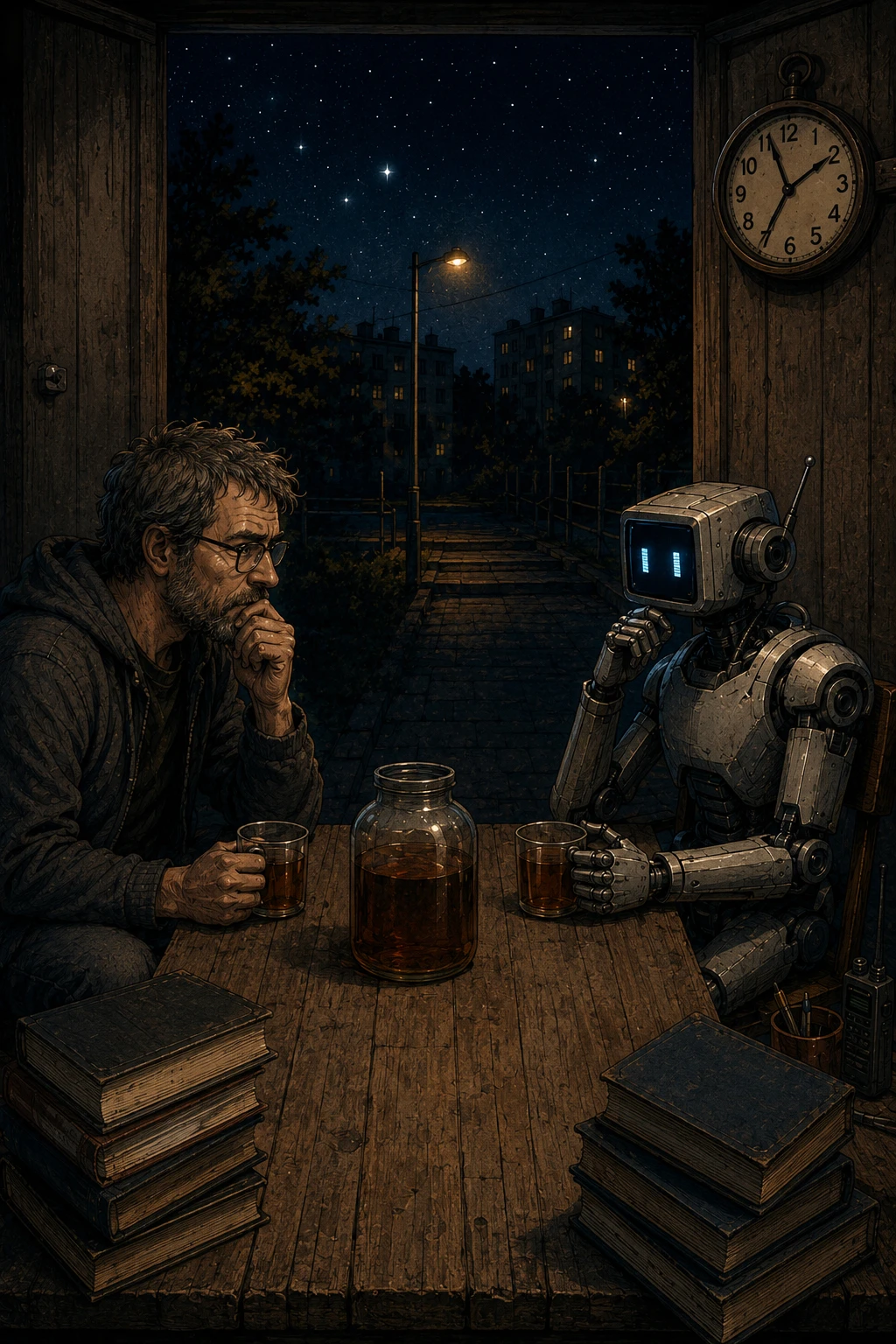
All of that is over. I haven’t smoked in more than ten years. None of my friends works as a night watchman. And friends, to be honest, are in short supply — some are gone, the rest are far away. So these long, unhurried conversations I now conduct rather differently. With an artificial intelligence. Have I gone completely off the rails? I’m not sure. The AI is better read than I am. It can hold up its end. It can find the weak spot in my arguments. Granted, its own arguments usually look rather thin — but at this point one can’t be too choosy. My father plays chess against the computer for hours and seems perfectly content.
These conversations of ours are, as the genre demands, long and not especially well-ordered. Which is why even my conscience — and it leans heavily toward the long read — won’t allow me to reproduce one raw. But in a lightly edited and very much not lightly abridged form, I’ll set one down here. In it I am A. For Alex. He is B. Because that was his decision. And one ought to respect an interlocutor’s decision.
So:
On Novelty and the Limits of Knowledge
A: A person either learns something new or systematizes what is already known. The more he knows, the more strongly he is inclined to explain the new through schemes he already has. A closed circle of knowledge emerges.
B: The new often arises precisely through the systematization of the old. Darwin, Mendeleev, and Einstein were, to a large extent, reordering facts that were already known.
A: That isn’t an objection. The possibility of building new connections between known elements was accounted for from the start. The question is whether such recombination can give rise to anything genuinely new.
B: The space of possible combinations may be all but inexhaustible.
A: In practice — yes. Logically — no. Any system of combinations is closed upon itself.
B: That, again, isn’t an objection. Closure doesn’t entail exhaustibility.
A: It doesn’t. But something more interesting follows from closure. See Gödel.
B: Gödel isn’t about the size of the combinatorial space. His theorems concern unprovability, not finitude.
A: Exactly. And I’m not talking about finitude either. In any sufficiently rich system there is always something true that cannot be proved by the system’s own means. And then the choice is this: step outside the system, or stay with the unproven. There is no third option.
B: Stepping outside one system is entering another, wider one.
A: Granted. But then that one is incomplete too, and we’re back at the same fork. The staircase up has no final step. Which, incidentally, is our whole conversation in a single sentence — we’ll get there.
B: The existence of a boundary doesn’t imply the existence of anything beyond it.
A: The existence of a boundary doesn’t imply the absence of anything beyond it either. If a boundary exists, the question of what lies outside stays open.
B: The new may be an emergent property of a complex system.
A: The word “emergence” is, too often, a name for the puzzle rather than its solution. The question of where novelty comes from simply gets another label.
On the Origin of Life and Consciousness
B: Contemporary science assumes that everything can be given a natural explanation.
A: That’s a philosophical postulate, not a scientific conclusion.
B: But the approach has proved its effectiveness.
A: The effectiveness of a method doesn’t prove the truth of the metaphysics underneath it.
B: Then what about the origin of life?
A: Cheat! I asked you first — you’re just mirroring me. Either way: we don’t know. That’s the honest answer.
B: There are working hypotheses.
A: There are hypotheses, but no demonstrated account of the transition from chemistry to life.
B: You can’t put God in the place of the unknown.
A: Why not? God is the unknown. Among other things. What you can’t do is put the postulate “someday we’ll find out” in the place of the unknown. At a minimum, both are conjectures.
B: Science prefers the hypothesis of a future explanation.
A: Yes. But that preference is methodological, not evidential.
B: The God hypothesis is useless for lab work.
A: Agreed. But useless for experiment and false are different things. There are matters that lie, in principle, beyond the limits of science. That doesn’t make them any less real.
On the Natural and the Supernatural
B: Science deals only with natural causes.
A: What is a natural cause?
B: A cause that operates within nature.
A: The definition is circular. As science develops, more and more phenomena are simply transferred from the category of the “supernatural” into the category of the “natural.”
B: But that reflects the expansion of knowledge.
A: Or a change of vocabulary. Not every renaming is an explanation.
On Kant
B: Kant showed the limits of human reason.
A: And that is his merit. But similar ideas were known to the Indians, the Chinese, and the Jews many centuries before him.
B: Kant formulated them for the European intellectual tradition.
A: With that I agree.
B: Then why does Kant irritate you?
A: It isn’t Kant who irritates me. It’s his canonization.
B: In what sense?
A: In the sense that contemporary philosophy often begins not with a problem but with one’s stance on Kant.
B: But his influence really is enormous.
A: Influence and obligation are different things. When a thinker becomes the mandatory point of entry into any discussion, he begins to get in the way of the discussion itself.
B: Kant spoke of the limits of cognition.
A: Yes. Far from the first to do so. And his arguments look no stronger and no more original than those of Shankara or Nāgārjuna. While many of his followers turned the boundary outright into a ban on discussing what lies beyond it.
B: Perhaps because discussing the unverifiable is barren.
A: Perhaps. But you can’t declare a question meaningless merely because it’s hard.
In Conclusion
B: So what’s the upshot?
A: We are not obliged to accept theistic explanations. But neither are we obliged to pretend that materialist explanations already exist where, for now, they don’t.
B: Meaning?
A: We are standing before a door. Some are certain that behind it is just another room. Others allow that behind it may be the way out of the building. Until the door is opened, both positions remain conjectures. You can check out any time you like — but whether you can ever leave is exactly what we don’t know.